
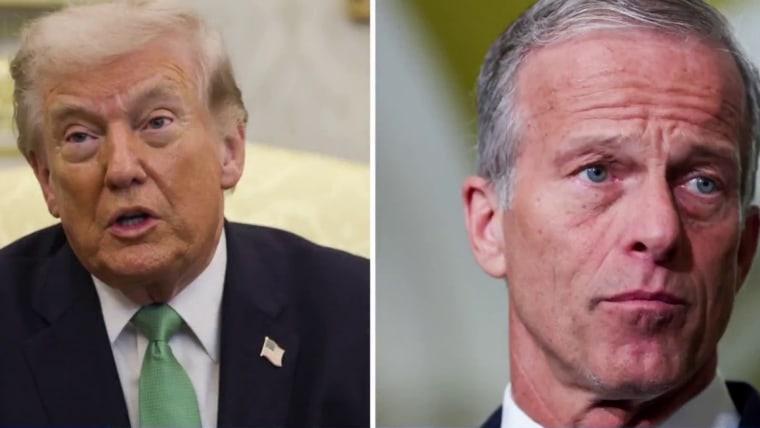
WASHINGTON — On Sunday, Senate Majority Leader John Thune, R-S.D., discussed an off-ramp with President Donald Trump to reopen TSA and end the long lines and delays at airports.
It would fund all of the Department of Homeland Security except for ICE, which Democrats have refused to support without new limitations on immigration enforcement operations, two sources with knowledge of the conversation told NBC News.
White House aides initially conveyed the idea to Trump and, after that briefing, Thune spoke with the president, the two sources said. Thune discussed the idea with Republicans on Capitol Hill, one of the sources said. The second source said it’s seen by numerous Republicans as a viable path to break the logjam.
ICE would be funded separately by Republicans in a party-line “reconciliation” bill that can pass without the need for any Democratic support later in the year.
The Department of Homeland Security has been shut down for more than a month, and while key operations, such as TSA and the Federal Emergency Management Agency, are still operating, many of those employees are working without pay. As NBC News reported this weekend, more than 400 TSA officers have quit since the shutdown began. Immigration and Customs Enforcement is also shut down, but its employees are being paid through Trump’s big beautiful bill passed last year.
Republicans believe that the off-ramp Trump and Thune discussed would win support from Democrats, who have offered to fund noncontroversial parts of the Department of Homeland Security on the Senate floor while the two parties continue to negotiate on immigration.
But Trump rejected it — as he made clear in a Truth Social post Sunday night.
“I don’t think we should make any deal with the Crazy, Country Destroying, Radical Left Democrats unless, and until, they Vote with Republicans to pass ‘THE SAVE AMERICA ACT,’” Trump wrote, while instead calling on Republicans to “Kill the Filibuster, and stay in D.C. for Easter, if necessary.”
Trump’s first two ideas aren’t viable. Democrats are determined to sink the SAVE America Act, which doesn’t have enough support to pass. And Republicans have made clear they lack the votes to nuke the filibuster. They may, however, cancel recess if there’s still no deal by the end of this week.
The conversation with Thune and Trump was first reported by Punchbowl News.
Speaking Monday in Memphis, Tennessee, the president doubled down on his demands to pair Homeland Security funding with the voting bill.
“You don’t have to take a fast vote. Don’t worry about Easter, going home. In fact, make this one for Jesus. OK, make this one for Jesus,” Trump said, adding: “The most important part of homeland security is voter ID and proof of citizenship. Nobody can vote on Homeland Security without voter ID or proof of citizenship.”
Senate Minority Leader Chuck Schumer’s office said that Democrats will again seek unanimous consent to fund just the TSA on the Senate floor Monday, for the eighth time.
Republicans have so far rejected those stand-alone bills.
If Trump were to change his mind and accept the Thune-GOP idea, it carries benefits for both parties. For Republicans, they could avoid giving into Democratic demands, such as requiring immigration enforcement officers to remove their masks and requiring judicial warrants to conduct raids. For Democrats, they could keep their fingerprints off ICE funding, which has become toxic with their base since Homeland Security agents killed protesters Alex Pretti and Renee Good in Minneapolis.
“We can be out of this shutdown by the end of the week,” Sen. John Kennedy, R-La., said Sunday. “Here’s what we do. The Democrats are amenable to opening up everything at DHS but ICE. We should accept that. The very next day, we should file a budget resolution through reconciliation that funds ICE as we deem appropriate. We don’t need Democratic votes to do that.”
Democrats are also planning to seize on the Trump social media post to argue that he owns the shutdown and travel chaos.
Reconciliation bills are arduous, requiring near-unanimous support among Republicans, especially given the tiny House majority. There has been deep skepticism that the party could pull it off, even if it tried. But needing to fund an agency like ICE would raise the impetus to use that path.
Under the “big, beautiful bill” passed by Republicans last year, ICE received a cash infusion of about $75 billion for the next four years to help carry out Trump’s mass deportation program.
The path comes with another possible upside for the White House: Some Trump allies have proposed reconciliation to approve supplemental funding for Trump’s war in Iran. It’s not clear that could win enough Democratic support.