

For decades, Africa has lagged the world in energy consumption, accounting for less than 5% of global energy supplies despite being home to a fifth of the world’s population. The continent also accounts for a mere 2% of global manufacturing output, with the majority of African nations exporting raw minerals and agricultural products while importing expensive finished goods. However, Africa now leads the world in a foundational, starter industry considered critical for industrialization: cement production. Indeed, across the continent we’re seeing a cement plant construction boom driven by rapid urbanization and massive infrastructure projects. A total of 16 African nations are now building new cement kilns. Data from the Global Energy Monitor (GEM) reveals that African nations now dominate the global pipeline for new cement plants, accounting for 42% of all cement production capacity currently being built across the globe.
Currently, Africa has around 441 million metric tons of annual cement production capacity in operation, good for 8% of the global total. However, the continent also has 43.3 million tons of annual capacity under construction, while African nations have announced plans for another 23 million tons, bringing total capacity to over 507 million tons, or 15% of the global total.
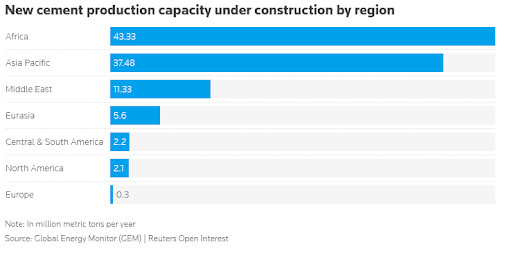
Source: Reuters
Nigeria leads the pipeline for capacity under construction in the continent with 10 million tons currently being built, ranking second globally only to India. As Africa’s leading cement manufacturer, Dangote Cement Plc is executing a $1-billion pan-African expansion strategy through 2030 to reinforce its market dominance. Dangote is currently upgrading its export terminals in Lagos to boost shipments to West and Central African neighbors.
Similarly, BUA Cement is closing the gap with its competitors through a $1.05-billion investment as the country expands its footprint toward an 80-million-metric-ton national capacity target by 2030. Under an engineering agreement with China’s Sinoma CBMI, BUA is constructing three new cement plants with a capacity of 3 million tonnes per annum (mtpa) each, nearly doubling its total output capability to 20 million tons annually.
In neighboring Cameroon, Taiwan Cement Corporation (TCC), via its acquired subsidiary CIMPOR recently completed a 1.2 million-ton cement plant that cuts emissions by 40% using calcined clay and cocoa shells for fuel, while Heidelberg Materials is constructing the world’s largest flash calciner in Ghana.
Meanwhile, Kenya’s cement industry is experiencing a significant wave of consolidation and multi-billion shilling expansions, with the country focused on achieving clinker self-sufficiency. The Devki Group has committed $385 million to build Kitui County’s first cement and clinker facility. Located in Mwingi North, the plant sits directly on vast local limestone deposits, and is designed to produce 3 million tonnes of clinker annually. Devki is also planning a 1.2-million-tons/year clinker plant in Kajiado, while Cemtech Ltd is constructing a $348 million clinker plant in West Pokot.
Libya, Angola, Uganda, Mali and Mozambique also have lined up major cement construction roadmaps that are among the world’s most ambitious, while installed capacity in Sub-Saharan Africa is projected to double from 280 million metric tons to over 500 million metric tons.
Africa’s cement boom could also mark the beginning of a much larger increase in energy demand.
Cement consumption typically rises early in the industrialization cycle as countries build housing, roads, ports and factories. Those projects then support the expansion of more energy-intensive industries, including steel, chemicals and manufacturing. Africa is already adding mineral processing, manufacturing and digital infrastructure such as data centers, all of which require significantly more reliable electricity.
Africa is already headed for the fastest growth in electricity demand anywhere in the world. The IEA expects net demand to rise 10.1%, from 799 TWh in 2025 to 880 TWh in 2027, as industrial activity and data centers consume more power. Now add dozens of new cement plants, including some of the largest projects under construction globally. Many are being built in countries that already struggle to keep the lights on.
That creates another opportunity because cement companies need enormous amounts of reliable power and have more incentive to produce some of it themselves. But for cement producers, power costs can determine whether a plant is competitive at all. Pakistan’s Bestway Cement has already installed solar farms across five plants to reduce its dependence on an unreliable national grid. Its Chakwal plant has 26 MW of solar capacity generating more than a quarter of the electricity needed to produce over 3 million tonnes of cement a year.
This post appeared first on https://oilprice.com