

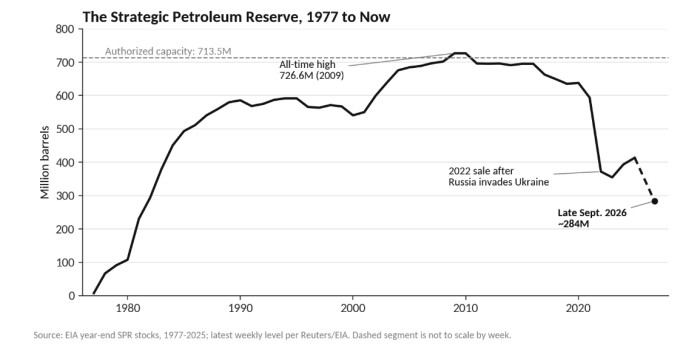
The U.S. Strategic Petroleum Reserve held just 283 million barrels of oil at the end of September, according to Reuters, the lowest level since October 1982, back when the reserve was still being filled for the first time.
It’s a scary-looking number, and most of the coverage has treated it that way. But the barrel count is the easy part of this story. Oil came out of those Gulf Coast salt caverns fast, because that’s exactly what the system was built to do. Getting it back in is slower, more expensive and more dependent on things nobody controls. And a good chunk of that work will land on whoever is running the Energy Department two or three years from now.
The Reserve Started This War Already Depleted
Congress created the SPR in 1975, after the Arab oil embargo showed how exposed an import-dependent America really was. The reserve peaked at 726.6 million barrels at the end of 2009 and spent most of the 2010s hovering around 695 million, according to EIA data.
Then came 2022. After Russia invaded Ukraine, the Biden administration sold 180 million barrels, which the Government Accountability Office calls the largest sustained drawdown in the reserve’s history, according to an October Atlantic Council brief. By the end of 2023, the SPR was down to 354.7 million barrels.
The reserve never really recovered. DOE bought back about 59 million barrels, and Congress canceled 140 million barrels of previously mandated sales so the hole wouldn’t get any deeper. Year-end stocks crept back to 413.5 million barrels in 2025. That’s roughly a quarter of what came out in 2022.
So when U.S. and Israeli strikes on Iran on Feb. 28 shut down most tanker traffic through the Strait of Hormuz, the SPR went into the fight at about 415 million barrels, or 58% of its authorized capacity of 713.5 million. In March, the U.S. committed 172 million barrels to a 400-million-barrel release coordinated by the International Energy Agency, the largest joint stock release the agency has ever authorized.
A Loan, Not a Sale
This is where 2026 gets different, and where a lot of the coverage gets fuzzy.
In 2022, the oil was sold. It left the caverns and didn’t come back unless someone later paid to replace it. This time, DOE is running the entire 172-million-barrel release as a series of exchanges. In plain terms, it’s a loan. Companies borrow crude now and pay it back later, in barrels, with interest.
And the interest is steep. Winning bidders in the first round had to return 18% to 22% more oil than they borrowed, two to seven times the premium DOE required in its last exchange in 2021. Later rounds pushed premiums as high as 28%. DOE says its earlier exchanges averaged a 25% premium and has pitched the program as refilling the reserve at no cost to taxpayers. Reuters reported the premiums work out to about 40 million extra barrels.
Why would anyone take that deal? Backwardation, which is a fancy way of saying oil for delivery today costs a lot more than oil for delivery a year or two out. A trader borrows a barrel while it’s worth, say, $100, sells it, and pays it back later, when the futures market says a barrel will be worth much less. As Employ America explained when the program launched, the premium is just the price of that trade.
In June, DOE offered 40 million barrels and awarded exactly 500,000, all of it to Vitol. Calendar spreads had collapsed, and the trade stopped making sense. When the futures curve flattens, nobody wants to borrow oil they’ll have to pay back with interest, and the barrels just sit there.
DOE put those same 40 million barrels back on the table on Sept. 29, the final tranche of the U.S. commitment, with bids due Oct. 6 and deliveries set for November and December, Oilprice.com reported. Before that, roughly 133 million barrels had gone out under earlier exchanges.
The repayment side has its own catch. The math only works if those companies can actually find the barrels when they come due, in a market the Atlantic Council warns may not be able to spare them. And the timeline is long. Return windows in some of DOE’s contracts run into late 2028, right up against the end of the current presidential term.
Nobody Agrees Where the Bottom Is
Here’s what everyone actually wants to know: how low can the SPR go before something breaks?
The honest answer is that it depends on who you ask, and the range is enormous.
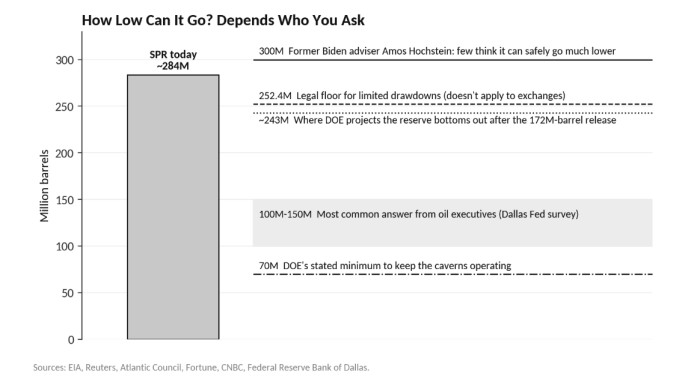
DOE says there’s plenty of room left. The oil sits on top of salt water in the caverns, so as crude comes out, brine takes its place. Energy Department spokesman Ben Dietderich told CNBC the caverns are “always full” and that the only thing that changes is “the ratio of oil and water.” The department’s stated minimum to keep the system running is about 70 million barrels.
That’s the physical floor, according to Siddharth Misra, a petroleum engineering professor at Texas A&M. It’s the least oil you need to keep the extraction pipes sitting in crude instead of water. But Misra puts the practical floor at 250 million to 300 million barrels, and he told Fortune the industry should be “highly concerned about the integrity of the caverns” any time inventories drop below 300 million. Amos Hochstein, a former senior energy adviser to President Joe Biden, has said he doesn’t know anyone who thinks the reserve can safely go much below 300 million.
In the Dallas Fed’s third-quarter energy survey, the most common answer from executives, picked by 31% of them, put the practical floor between 100 million and 150 million barrels. Another 19% said 250 million to 300 million, according to Rigzone.
Congress set a floor of 252.4 million barrels, but it only applies to smaller drawdowns the energy secretary orders without a presidential emergency finding. Exchanges don’t fall under it. DOE projects the reserve will bottom out around 243 million barrels once the full 172 million barrels are delivered, below the line that would stop a limited drawdown. And this isn’t a new worry. A 1981 GAO report advised against releases below 250 million barrels except in a “very severe emergency.”
Out at 1.4 Million Barrels a Day, Back In at a Trickle
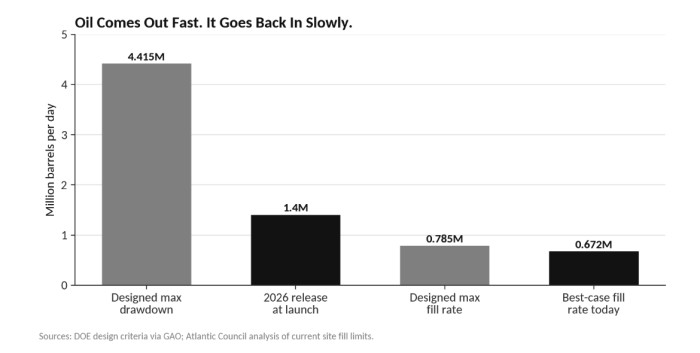
The SPR was designed to release oil about six times faster than it can take it back in. Its design criteria call for a peak drawdown rate of 4.415 million barrels a day against a fill rate of 0.785 million. That made sense for a reserve built for emergencies. It makes refilling a slog.
And the real system can’t hit those design numbers anyway. As of December 2025, the GAO found the SPR could draw down at 61% of its designed rate and fill at just 56%. Even during 2022, a release run at just over a fifth of the designed maximum still needed repeated emergency repairs to leaking pipes and pumps.
The Atlantic Council ran the numbers site by site. Bryan Mound, West Hackberry and Big Hill can each take in up to 225,000 barrels a day, but problems with West Hackberry’s brine disposal wells have cut it to 112,000. Bayou Choctaw tops out at 110,000. Under perfect conditions, that’s 672,000 barrels a day across the entire system, compared with the 1.4 million barrels a day that flowed out when the releases started in March.
At that pace, the 133 million barrels owed from the exchanges take at least 198 days to put back. Add the 20 million to 30 million barrels still owed from earlier congressional requirements, and the fill system has to run flat out for 220 to 230 days. The brief’s authors say it could realistically take twice that, given what a sustained fill will do to aging infrastructure.
The infrastructure itself is part of the problem…
Three of the six caverns at Bayou Choctaw have only one drawdown left before they risk losing structural integrity. A well at Bryan Mound failed without warning in May 2024 and lost an estimated 400,000 barrels. And Sandia National Laboratories, the reserve’s longtime geotechnical adviser, concluded in late 2024 that well deformation is outpacing DOE’s ability to fix it at current funding levels. Energy Secretary Chris Wright has said the immediate priority is to “finish the repairs on the Strategic Petroleum Reserve.”
The $20 Billion Problem
The exchanges are DOE’s answer to the money question. They bring barrels back without a check from Congress. But they only bring back what was lent, plus the premium.
The reserve entered the war at about 415 million barrels. If all 172 million borrowed barrels come back with roughly 40 million barrels of interest on top, it lands somewhere around 455 million. That’s our own back-of-the-envelope estimate, it assumes everything goes right, and it still leaves the reserve at only about two-thirds of the roughly 680 million barrels DOE says the system can effectively hold.
Getting the rest of the way means buying oil. DOE has estimated it would cost about $20 billion to buy the roughly 250 million barrels needed to get back to that effective peak, at prices near $80 a barrel. Congress set aside $171 million for crude purchases in last year’s reconciliation law, enough for about 2 million barrels. As of May, DOE had spent it on a single contract for 1 million barrels.
The administration has floated refilling with Venezuelan crude, an idea that dovetails with Washington’s growing stake in Venezuela’s oil fields. The problem is chemistry. Orinoco crude has an API gravity of 9.5 to 12 degrees, and Venezuela’s main export grade, Merey 16, sits at 16. DOE told Congress back in 2016 that it doesn’t store anything heavier than 22.3 API because the operational headaches outweigh the benefits.
So “no cost to taxpayers” holds up for the exchange barrels. For the reserve as a whole, it’s optimistic. Somebody eventually has to pay to fill the rest, and that bill doesn’t show up anywhere in the current budget.
What If It’s Needed Again?
Gulf exports have recovered to 81% of pre-war levels, but tanker attacks keep flaring and Brent is back above $100. Oil executives in the Dallas Fed survey most often picked the second quarter of 2027 as the point when Persian Gulf exports get back to normal. On Oct. 2, the G7 agreed to release another 100 million barrels of crude and diesel over four months, on top of March’s record IEA action. And global inventories are already badly depleted after eight months of conflict.
The SPR isn’t only there for wars, either. It sits in 60 salt caverns on the Texas and Louisiana coast, the same stretch of coastline bracing for a hurricane this week. The reserve released 11 million barrels after Hurricane Katrina in 2005. A thinner reserve means a thinner cushion for domestic disasters, too.
Then there’s what the refill does to prices. Pumping oil back into the SPR is new demand. PVM estimated in August that returning 200 million barrels over two years would mean roughly 280,000 barrels a day flowing into storage, almost 3% of U.S. consumption, which would likely firm up the WTI forward curve. The Atlantic Council put it more bluntly: if the conflict isn’t resolved, there simply aren’t enough barrels to refill the reserve without another round of price increases.
To be fair, the U.S. isn’t the import-dependent country the SPR was built to protect. It’s been a net petroleum exporter since 2020 and is no longer bound by the IEA’s rule requiring 90 days of import cover. Commercial crude stocks have held up far better than the reserve has. But a net exporter still buys and sells at world prices, and 2026 has been an expensive lesson in what happens when a fifth of the world’s seaborne oil gets stuck behind one chokepoint.
The drawdown took about seven months. Putting the oil back depends on traders honoring loans in a tight market, on caverns that are already showing their age, on a refill bill nobody has budgeted for, and on a war ending on schedule. If any one of those goes sideways, the next emergency arrives with even less in the tank.
This post appeared first on https://oilprice.com